Quartz spent the last decade learning to look like stone that came out of the ground, and in 2026 that work shows. The slabs moving through our Burnsville showroom this year read warmer than they did three years ago. They feel softer under your hand. The veining runs through the full thickness of the slab instead of sitting on top of it, so a mitered edge or an undermount sink cutout shows the same pattern as the surface.
If you are planning a kitchen or bath remodel in the Twin Cities this year, these are the design directions worth knowing before you start pulling samples.
What Are the Top Quartz Countertop Trends for 2026?
Seven shifts define quartz countertop design in 2026:
- Warm neutrals over cool gray. Creamy ivory, greige, taupe, and mushroom backgrounds replace the stark white and steel gray that dominated 2019 through 2023.
- Matte, honed, and leathered finishes. High-gloss polish gives way to surfaces with texture you can feel.
- Quartzite-inspired patterns. Manufacturers are printing and pressing designs that copy Taj Mahal, Fusion, and Calacatta Viola rather than generic marble.
- Full-body veining. Pattern that carries through the slab depth, not just the face.
- Dark statement surfaces. Black and deep charcoal quartz on islands, waterfall panels, and feature walls.
- Thicker, softer edge profiles. Mitered 3cm and 6cm edges, eased corners, and waterfall returns.
- Quartz beyond the counter. Full-height backsplashes, fireplace surrounds, shower walls, and bar fronts in the same slab.
Warm Neutrals Replace Cool Gray and Stark White
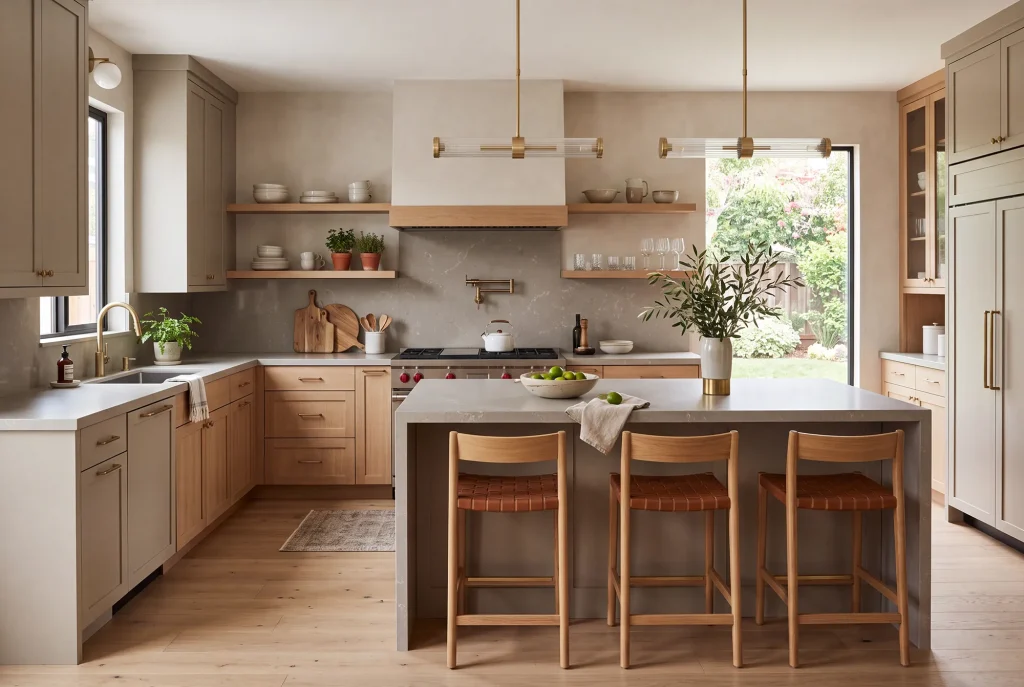
The tonal shift is the biggest story of 2026. At the Kitchen & Bath Industry Show in February, nearly every surface manufacturer led with creamy off-white backgrounds carrying veining in taupe, sand, chocolate, and soft gold. The industry calls it warm minimalism or quiet luxury. In practice it means your countertop no longer fights the room.
Minnesota homeowners have a specific reason to pay attention here. Our winter light runs flat and blue for a solid five months. A cool gray quartz amplifies that, and kitchens that photographed beautifully in July can feel clinical by January. A cream or greige background pushes back against the blue cast and keeps the room feeling lit from within.
Warm neutrals also pair with what cabinet shops are building. White oak still leads, walnut is climbing, and both look better against a warm slab than a cold one. If you are working through cabinet finishes at the same time, our guide to matching stone countertops with kitchen cabinets walks through the pairings.
White quartz is not going anywhere, to be clear. The white that sells in 2026 is a warm white with visible movement, not the bright optical white of a builder-grade slab. See our breakdown of white quartz countertop options for the range.
Matte and Leathered Finishes Move Past High Gloss
Polished quartz reflects light and shows every fingerprint. Homeowners noticed. Matte and honed finishes now account for a growing share of what we fabricate, and leathered quartz has moved from specialty request to standard option in several brand lines.
A honed surface reads soft and chalky. A leathered surface adds a light texture you can feel with your palm, closer to the hand of natural stone. Both hide water spots and smudges better than polish, which matters on a kitchen island where four people set down glasses every evening.
The tradeoff: matte and leathered surfaces can show oil marks from cooking more readily than polished surfaces, and they need a wipe-down with warm water and mild soap rather than a spray-and-buff. Our guide to quartz countertop finishes compares all three side by side, and our quartz cleaning guide covers daily care.
Quartz That Reads Like Quartzite
Marble-look quartz has been the default for years. In 2026 the reference material changed. Manufacturers are chasing quartzite, and specifically the warm, glassy quartzites that homeowners fall for at the slab yard: Taj Mahal, Fusion, Sea Pearl.
High-definition printing and full-body color technology are the reason it works now. Older marble-look quartz put the pattern on the face of the slab, so a mitered edge or a bullnose exposed a plain core. Current full-body designs carry the veining through the thickness, which means the pattern continues across an undermount sink cutout and around a waterfall corner.
If you have been comparing the two materials, our guide on quartz versus quartzite covers where each one earns its keep. Quartzite is beautiful and harder than granite, but it needs sealing and it costs more to fabricate. Quartz gets you close to the look with no sealing and a manufacturer warranty.
Dark Quartz Islands and Black Feature Surfaces
Black surfaces showed up across the show floor at KBIS this year, often with bold veining in cream, gold, or crisp white. Designers are using them as focal points rather than whole-kitchen material.
The pattern we see most in Twin Cities remodels: light perimeter counters, dark island. A cream quartz on the runs, a deep charcoal or near-black with warm veining on the island, waterfall panels on both ends. The island becomes furniture. It also solves a practical problem, since the island takes the most abuse and dark surfaces forgive more.
For layout and proportion questions before you commit, see our kitchen island trends and ideas.
Thicker Edges and Waterfall Returns
Edge profile is doing more design work than it used to. Ogee and bullnose have faded. What sells now is a clean eased edge on a 3cm slab, or a mitered edge that builds the apparent thickness to 2 inches or more while keeping the material cost reasonable.
Waterfall islands are still climbing. A waterfall panel runs the slab down the side of the island to the floor, and the pattern match at that corner is where fabrication skill shows. Our shop cuts and joins those miters in-house, which is why we can control the vein match rather than hoping it lands.
Thickness affects budget, seam placement, and support requirements. Our guide to the best thickness for quartz countertops explains what changes between 2cm and 3cm.
Quartz Beyond the Countertop
Homeowners are running the same slab up the wall. Full-height backsplashes behind the range are now a standard request instead of a splurge, and we are fabricating more quartz shower surrounds, fireplace faces, bar fronts, and floating shelves than in any previous year.
The appeal is continuity. A tile backsplash introduces grout lines and a second material. A slab backsplash reads as one surface, wipes clean in a pass, and makes a small kitchen feel larger. If you have a remnant-sized project in mind, our post on creative uses for quartz around the home has ideas, and our guide to matching countertops with stone backsplashes covers the pattern decisions.
Which Quartz Brands Are Leading These Trends?
Every major line released warm neutral and quartzite-look designs for 2026. Silestone continues to build out its low-silica HybriQ collections, MSI Q expanded its high-definition Q+ designs, Viatera and Vicostone both pushed further into full-body veining, and HanStone leaned into textured finishes.
We carry Aggranite, Daltile ONE, HanStone, MSI Q, Quantra, Silestone, Viatera, Vicostone, and Wilsonart. Availability moves through the year, so the honest answer to “which brand has the color I want” changes month to month. Our comparison of popular quartz brands covers how they differ on warranty, price tier, and pattern range, and Silestone countertops in the Twin Cities goes deeper on that line.
How Do You Choose a Quartz Countertop That Will Not Look Dated?
Pick the slab that answers your room, not the one that answers the trend report. Three questions sort most decisions:
- What is your cabinet finish? Warm wood wants a warm slab. Painted white or gray cabinets give you more latitude.
- How much light does the kitchen get? North-facing Minnesota kitchens need the warm end of the palette. A south-facing room with big windows can carry cooler tones.
- How long are you staying? Planning to sell in three years pushes you toward broad-appeal neutrals. Staying twenty years means you should buy what you love. Our post on quartz countertops and home resale value covers the return side.
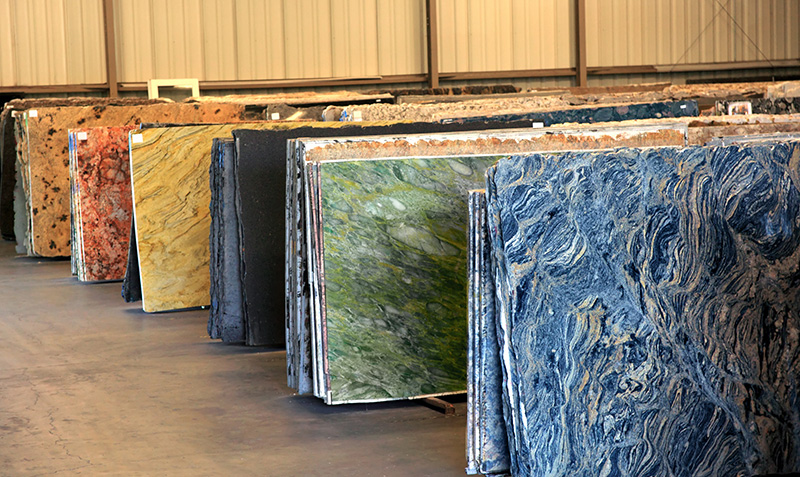
One more piece of advice from twenty-plus years of walking homeowners through this: look at the full slab, not the sample chip. A 4-inch sample tells you the color. It tells you nothing about where the veining lands on your island. We partner with nine slab selection centers across the Minneapolis and St. Paul metro so you can see the whole piece before you commit, and we also keep in-stock quartz slabs with a two-week order-to-install window.
Quartz Trend Questions We Hear in the Showroom
What quartz color is most popular in 2026?
Warm white and cream backgrounds with soft taupe or gold veining lead the year. Greige and mushroom tones follow. Cool gray is still specified but at a fraction of its 2021 volume. Browse current quartz color options to see the range in person.
Are white quartz countertops still in style?
Yes. White quartz remains the most requested category in our showroom. The style change is in the undertone. Warm whites with visible movement have replaced bright optical whites with minimal pattern.
Is matte or polished quartz better?
Neither is better across the board. Matte and honed finishes hide fingerprints and water spots and suit the warm, tactile look leading 2026. Polished finishes reflect more light, which helps in a small or dark kitchen, and they resist oil marks better. Both carry the same durability and the same warranty.
Do quartz countertops need to be sealed?
No. Quartz is a nonporous engineered surface and never needs sealing. Soap and water handles daily cleaning. Our page on quartz countertop sealing explains why.
Can quartz go outdoors on a patio or grill island?
Most quartz manufacturers do not warranty outdoor installations, since UV exposure can fade the resin binder over time. Granite is the better outdoor choice in Minnesota. See granite or quartz outdoors for the full comparison.
How much do quartz countertops cost in the Twin Cities?
Our countertops start at $49 per square foot installed. Final pricing depends on the brand and color tier, slab thickness, edge profile, sink and cooktop cutouts, and total square footage. A free estimate gets you a real number for your kitchen.
See the 2026 Quartz Trends in Person
Trend articles can point you in a direction. They cannot tell you how a slab looks under your kitchen lights next to your cabinet door. Bring your cabinet sample and your paint chip to our Burnsville showroom and we will pull the quartz colors that work with them. We fabricate and install in-house, we serve communities across the Twin Cities metro, and current order-to-installation time on in-stock surfaces runs about two weeks.
Request your free estimate or call (952) 882-1600 to start your project.